






The Best Design Museums in Europe

Europe holds the deepest concentration of design museums — institutions that collect and contextualize a century of typography, furniture, and applied art. The strongest lineup runs from the Vitra Design Museum and Bauhaus sites in Germany to London's Design Museum, Amsterdam's Stedelijk, and Milan's Triennale. This guide rounds up ten essential stops for anyone serious about visual culture.
Quick answer: For a short list: the Vitra Design Museum (Weil am Rhein) for design history staged inside significant architecture, the Design Museum (London) for contemporary product and graphic design, the Bauhaus sites in Dessau and Berlin for the movement's own archive, and the Stedelijk (Amsterdam) for where design and modern art overlap. Each covers a different era and a different way of reading the same century of design.
Vitra Design Museum — Weil am Rhein, Germany
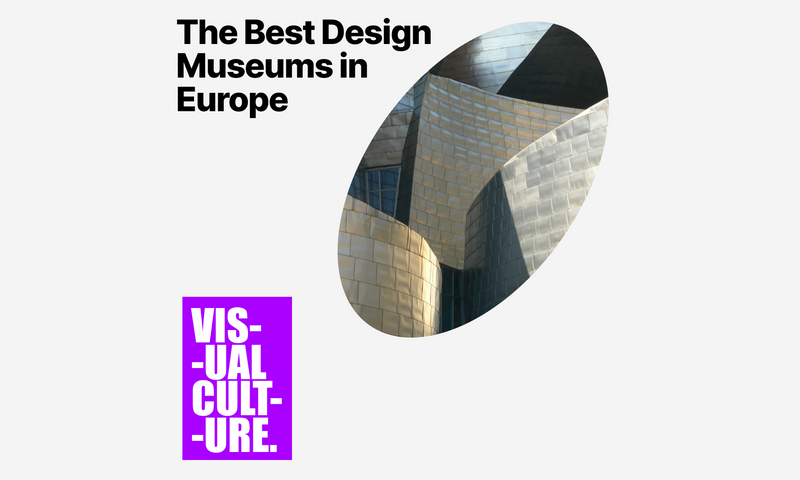
Weil am Rhein, just across the German border from Basel, is anchored by the Vitra Design Museum's deconstructivist Frank Gehry building — his first project in Europe. Rotating exhibitions on furniture, industrial design, and individual designers join a permanent collection, and the Vitra Campus adds buildings by Zaha Hadid, Tadao Ando, and SANAA — design history in three dimensions, not behind glass.
Design Museum — London, UK
London's Design Museum occupies a reworked Kensington exhibition hall built around a soaring timber-lined atrium — the UK's primary showcase for product, graphic, fashion, and digital design. Free permanent galleries trace a century of design through everyday objects, while fast-moving temporary shows spotlight individual designers — the most accessible stop here for anyone whose interest in design runs through consumer culture, not art history.
Bauhaus Dessau & Bauhaus-Archiv, Germany
The Bauhaus relocated from Weimar to Dessau in the mid-1920s; Walter Gropius's school building there — glass curtain walls, workshops instead of classrooms — is now a UNESCO World Heritage Site. Berlin's Bauhaus-Archiv holds the largest collection of Bauhaus objects and documents anywhere, from Marcel Breuer's furniture to Herbert Bayer's typography; while its new building is under construction, visitors go to its project space, the Temporary Bauhaus-Archiv, in Berlin-Charlottenburg. Together, the two sites are design's closest thing to a pilgrimage — one tested the movement's ideas, the other archives its legacy.
Stedelijk Museum — Amsterdam, Netherlands
Amsterdam's Stedelijk covers modern and contemporary art, but its design credentials run deep: a major De Stijl holding, including Rietveld furniture alongside the Mondrian paintings, plus a standing design and applied-arts collection. The building makes the same case — a 19th-century hall extended by a smooth white addition locals nicknamed "the bathtub." It's a museum for anyone who treats design and fine art as one conversation.
MAK – Museum of Applied Arts — Vienna, Austria
Vienna's MAK, one of Europe's oldest applied-arts museums, is a survey of furniture, textiles, glass, and design history in the tradition of London's V&A, with particular depth in the Wiener Werkstätte, the workshop that shaped Vienna's early-twentieth-century design language. Its holdings include preparatory work tied to Gustav Klimt's Stoclet Frieze. Permanent galleries mix historical and contemporary work — less archive than an ongoing argument about what applied art is for.
Triennale Milano & ADI Design Museum — Milan, Italy
Milan carries two essential stops. The Triennale, housed in Giovanni Muzio's 1933 Palazzo dell'Arte in Parco Sempione, has run design and architecture exhibitions since the 1930s and remains one of design's most respected curatorial voices. Nearby, the ADI Design Museum holds the Compasso d'Oro collection — Italy's oldest, most prestigious design award — inside a converted power station, tracing Italian product design from postwar reconstruction to today.
Musée des Arts Décoratifs — Paris, France
Paris's Musée des Arts Décoratifs occupies the Marsan wing of the Louvre — a statement about how seriously France treats decorative arts. The collection runs from medieval objects through Art Nouveau and Art Deco to contemporary design, with fashion, textile, and advertising holdings rotating through temporary shows — the deepest well here for tracing where graphic and product design draw from ornament and decorative tradition.
Design Museum Gent — Ghent, Belgium
Ghent's Design Museum pairs an 18th-century mansion with a modern extension: period rooms carry Rococo, Art Nouveau, and Art Deco interiors, while the contemporary wing houses industrial and graphic design from the twentieth century onward. It's a smaller, more focused visit than the major capitals — easy to cover in a couple of hours. Paired with the Stedelijk on a Belgium-Netherlands itinerary, it adds the decorative-arts throughline Amsterdam skips.
Moderna Museet — Stockholm, Sweden
Stockholm's Moderna Museet is Sweden's national museum of modern and contemporary art — a Rafael Moneo-designed building on Skeppsholmen holding Picasso, Matisse, and Dalí alongside strong Nordic modernism. It isn't a design museum in the strict sense, but its posters, photography, and Nordic modernist objects trace how Scandinavian visual language developed alongside European modern art. Pair it with a design-specific stop for the other half of the story.
Red Dot Design Museum — Essen, Germany
Essen's Red Dot Design Museum occupies a former boiler house redesigned by Norman Foster, inside the Zollverein Coal Mine Industrial Complex, a UNESCO World Heritage Site. It houses winning entries from the Red Dot Design Award, one of the industry's most recognized product design competitions — a rolling record of contemporary industrial design. The raw setting makes it the most future-facing museum here: less where design came from, more where it's headed.
The Canon and the Edges
Design museums slow a century of movements down long enough to study them, preserving reference points that outlast whatever trend cycle produced them — groundwork for anyone who thinks about visual culture with rigor.
MoBe works a different angle on the same material: instead of formalizing a canon, we recontextualize vernacular graphic codes — overlooked, never meant to leave a street corner or a flyer — into pieces that hold a wall. Our own Abstract collection sits closer to that instinct: geometry and structure treated as the subject, not the decoration.
Related reading: Dreamed in Marseille · Bauhaus Posters: A Visual Guide · What “Museum-Grade” Really Means