








Slowly, With Both Hands: How to Flatten a Rolled Print

An unframed print usually arrives rolled in a tube, and for a little while it remembers the shape. Flattening it takes a few careful minutes and a day or two of patience. The gesture that matters most is the first unroll.
Quick answer: Unroll the print slowly on a clean, flat surface, with your hands spread along the edge so the whole width moves together — never by the middle or by a single point. Then lay it flat, image up, under the tissue it came in, with a few books on the corners, for a day or two. Still curling? Roll it loosely the other way for a few minutes and lay it flat again. No iron, no tape on the image, no folding.
Why a rolled print holds its curve
Our prints are made on uncoated fine art paper: natural white, acid-free, with real body and a soft, tactile surface. That body is what makes a sheet feel like an object rather than a page. It's also why a print that has traveled in a tube keeps the curve for a little while once it's out.
The curve is temporary: given time and a flat surface, the paper settles on its own. What a sheet with real body doesn't forgive is being forced. Bent hard at one point, it keeps the bend.
Before you open the tube
- Clean, dry hands.
- A clean, flat surface larger than the print. A table works better than the floor.
- For the largest sizes, a second pair of hands: one person at each side.
- The tissue the print came in. Set it aside; you'll need it.
Slide the print out of the tube gently, as one roll. Don't pull it out by a corner.
The unroll: hands along the edge
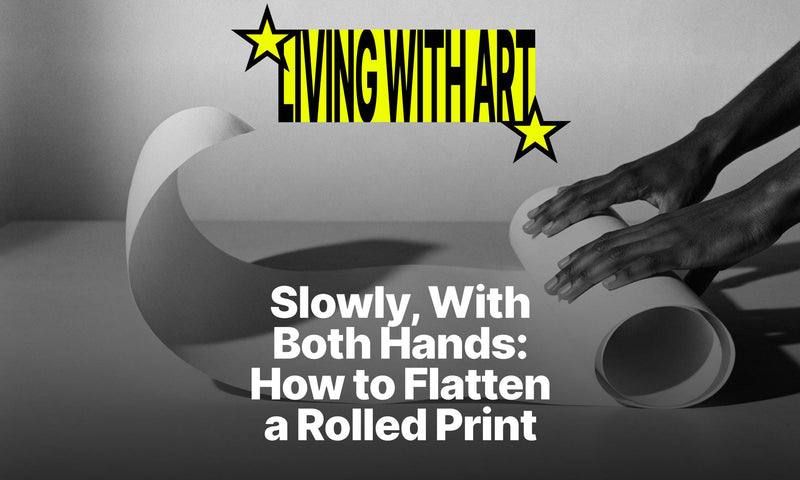
This is the step that matters. Lay the roll on the table and open it slowly, hands spread along the edge, so the whole width of the sheet moves at once.
The gesture to avoid is the opposite one: holding the sheet by the middle, or by a single point, while the rest of it is still curled. The paper bends where the pressure is. The larger the print, the more this matters — on the biggest sizes, two people working from either side is simply the easy way to do it.
Take your time. Nothing about this step rewards speed.
Let it rest flat
Once it's open, lay it flat, image up, under the tissue it came in, with a few books on the corners. Leave it for a day or two, a little longer for the largest sizes. A dry room helps. Keep it out of direct sun while it rests, as you will once it hangs.
If it still curls
Some sheets hold the memory of the tube a little longer. If yours still curls after a day or two, roll it loosely the other way for a few minutes, then lay it flat again under the tissue and the books.
Loosely is the word that counts. The point is to cancel the curve, not to make a new one.
What not to do
- No iron. Flattening is a matter of time, not heat.
- No tape on the image. If a corner needs holding while you work, use a book.
- No folding, not even to help it lie down. A sheet with real body remembers a fold.
- No rushing it into a frame while it still curls. Let it lie flat on its own first.
Then, framing
Once the print lies flat on its own, it's ready to frame. Most of our sizes follow standard formats, so an off-the-shelf frame fits easily; above 70 × 100 cm, those frames are rare. Look for acid-free mounts, and handle the sheet the way you unrolled it, hands spread along the edge. The same goes for the day you take a framed piece out of its frame.
Rather skip this step? Choose a framed piece: it arrives assembled and ready to hang. Framed or Unframed? How to Decide weighs the two.
The first unroll is the last bit of handling a print gets before it becomes part of a room. Give it a few careful minutes and a day of rest, and it's ready to hang. The step-by-step version also lives in our FAQ, under Care. Still choosing one? Start with the First Collection.
FAQ
How long does a rolled print take to flatten?
A day or two, laid flat, image up, under its tissue with a few books on the corners — a little longer for the largest sizes. If it still curls, roll it loosely the other way for a few minutes, then lay it flat again.
How do I avoid creasing a print when I unroll it?
Unroll it slowly with your hands spread along the edge, so the whole width moves together, and never hold the sheet by the middle or by a single point. On the largest sizes, unroll it with two people, one at each side.
Can I iron a print to flatten it?
No. Flattening is a matter of time, not heat: lay it flat under its tissue with a few books on the corners, and give it a day or two.
Keep reading: Framed or Unframed? How to Decide · Where to Hang Art in Every Room · Why Matte Changes How You See an Image